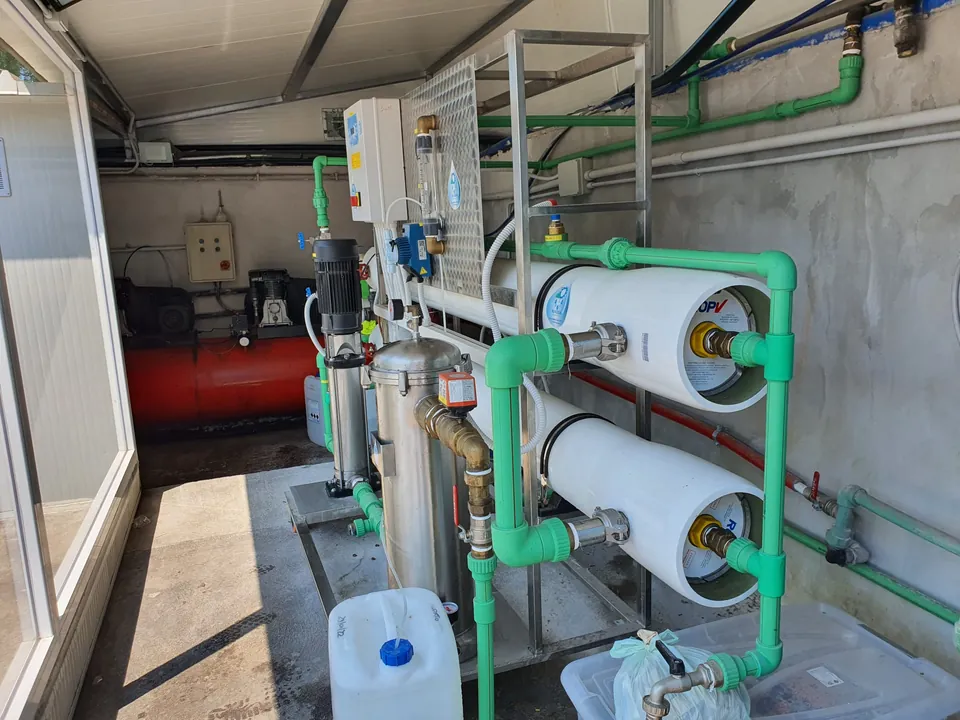
In many coastal areas groundwater is brackish. A reverse-osmosis desalination unit makes it usable for irrigation, production or civil use.
What brackish water is
It is water with a salinity between fresh water and sea water: roughly 1 to 10 grams of salts per litre, against about 35 for the sea. In coastal aquifers salinity rises when sea water seeps underground, a phenomenon made worse by heavy abstraction.
Why it is a problem
- In agriculture it reduces yields and, over time, builds up salts in the soil.
- In industry it causes corrosion and scaling and is unsuitable for most processes.
- For civil use it is not drinkable and damages plumbing and appliances.
How a desalination unit works
After pre-treatment to remove sediment, iron and chlorine, a pump pushes the water through reverse-osmosis membranes that hold back the salts. The pressure required depends on the salinity: the more salt, the more energy is needed. That is why membranes, pumps and materials must be chosen on the analysis of the water to be treated.
Besides desalinated water, the plant produces a saline concentrate that must be handled properly, in line with discharge regulations.
What to consider before installing one
- A full analysis of the water, not just salinity: iron, hardness and turbidity affect the pre-treatment.
- The flow rate you need, and for how many hours a day.
- The intended use: irrigation, process and drinking water have different requirements.
- The space available: plant room, canopy or plug & play container.
- Maintenance: pre-filters, dosing and scheduled cleaning keep the plant efficient.
The sizes we build. We build reverse-osmosis desalination units from 1,000 to 15,000 litres per hour, skid-mounted or containerised, for civil, irrigation and industrial use.