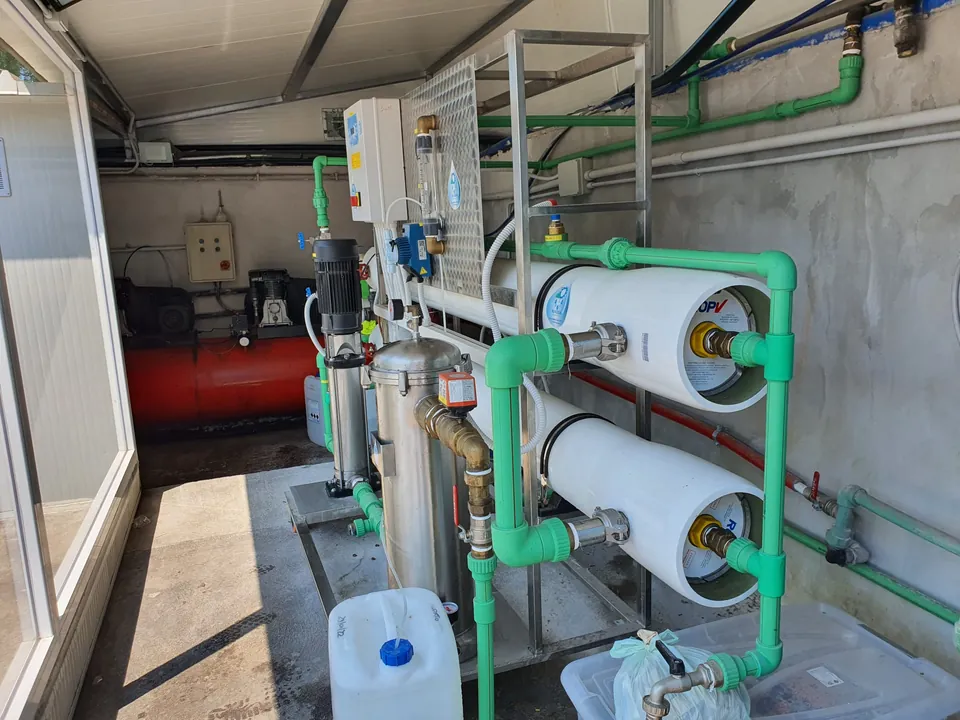
Reverse osmosis is the most complete technology for reducing salts, nitrates and dissolved contaminants in water. It is not the answer to every problem, though: knowing how it works helps you choose well.
How it works
In nature, osmosis moves water from a less concentrated solution to a more concentrated one through a semi-permeable membrane. In reverse osmosis a pump applies a pressure higher than the osmotic pressure and reverses the process: water passes through the membrane, while salts and contaminants stay on the other side.
Two streams therefore leave the plant: the permeate, which is the treated water, and the concentrate, which carries away what the membrane has held back.
What it removes
- Dissolved salts such as chlorides, sulphates and sodium: typically more than 95%.
- Nitrates, common in groundwater in farming areas.
- Arsenic and heavy metals.
- Hardness, meaning calcium and magnesium.
- Bacteria and viruses: the membrane is a physical barrier, but downstream disinfection is still good practice.
How a plant is put together
- Pre-treatment. Sediment filters, activated carbon or filter columns protect the membranes from turbidity, chlorine and iron.
- Dosing. An antiscalant stops salts precipitating on the membranes.
- High-pressure pump. It supplies the push required: the more saline the water, the more pressure is needed.
- Membranes. Housed in pressure vessels, they are the heart of the plant.
- Post-treatment. UV steriliser and any correction of the water to suit its use.
- Control panel. It keeps pressures, flows and conductivity under control.
When you really need it
Reverse osmosis is the right choice when water is brackish, when nitrates, arsenic or other contaminants exceed the limits, when an industrial process needs low-conductivity water, or when you want drinking water of consistent quality.
If the only problem is limescale, a softener is often enough; if it is just chlorine and taste, activated carbon may do. That is why there is no such thing as a “standard” plant.
The starting point is always the analysis. Salinity, hardness, iron and bacterial load determine the pre-treatment, the type of membranes and the size of the plant. Without this data you risk overspending or, worse, ruining the membranes within months.
How much maintenance it needs
Less than you might think, if the plant is properly sized: periodic replacement of pre-filters, checks on dosing and instruments and, when needed, membrane cleaning. With suitable pre-treatment, membranes work for years.

