A well means independence and savings, but its water is rarely ready to use. The good news is that almost any well water can be made fit for irrigation, production or drinking with the right treatment.
Signs you should not ignore
- Reddish stains on sanitary ware, floors and laundry: that is iron, which oxidises on contact with air.
- Dark or black deposits: often manganese.
- A rotten-egg smell: a sign of hydrogen sulphide.
- Drippers and filters that keep clogging: sand, silt and suspended iron.
- A salty taste: the water is brackish, which is common near the coast.
Many problems, however, are invisible: nitrates, arsenic and bacteria do not change how water looks.
The first step: analysis
A chemical, physical and bacteriological analysis tells you what is in the water and how much. For water intended for human consumption, Italian law (Legislative Decree 18/2023, implementing the EU Drinking Water Directive) sets these values among others:
| Parameter | Reference value |
|---|---|
| Iron | 200 µg/l |
| Manganese | 50 µg/l |
| Nitrates | 50 mg/l |
| Arsenic | 10 µg/l |
| Escherichia coli | 0 in 100 ml |
The treatments
Iron and manganese
These are removed with iron-removal filters: water passes through a filter medium that oxidises and holds back both metals. An automatic backwash cleans the filter periodically.
Sand and turbidity
Cartridge filters, quartz-sand columns or motorised self-cleaning filters, chosen according to the flow rate. For drip irrigation they are often the most important treatment.
Bacteria
A UV steriliser disinfects water without adding chemicals. Where there are storage tanks or long pipe runs, chlorination is added.
Salinity, nitrates, arsenic
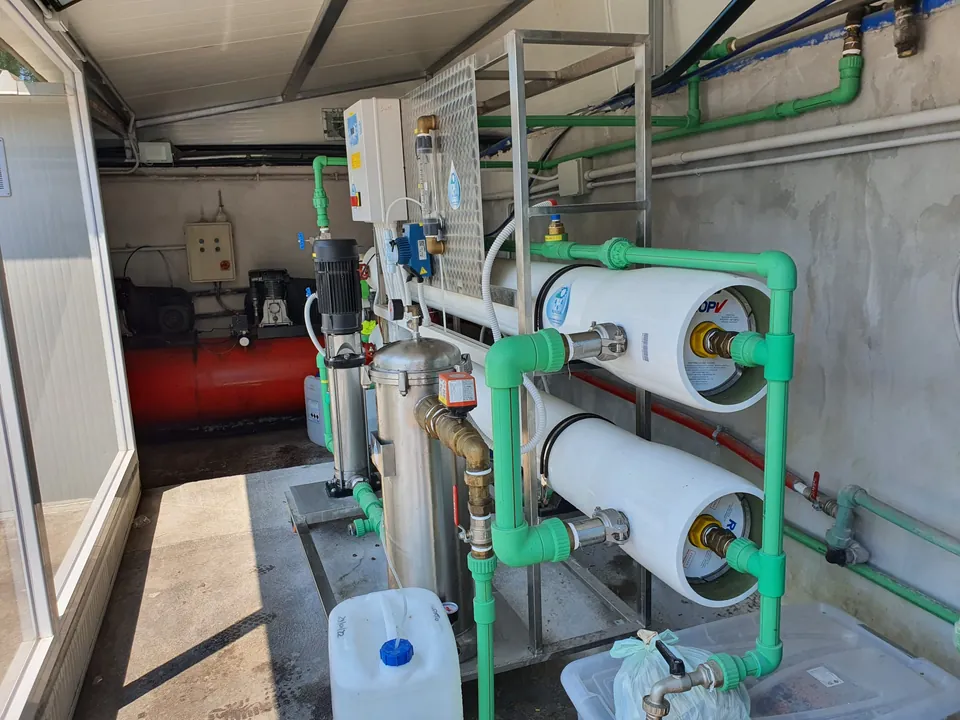
This is where reverse osmosis comes in, possibly together with selective resins or specific adsorbent media.
For irrigation or for drinking?
The intended use changes the design. For irrigation, filtration and iron removal are often enough to protect crops and drippers. For drinking, the water must meet every legal parameter, so the treatment is more complete and has to be verified with an analysis once the plant is running.
We analyse your well water free of charge. It is the data that lets us propose only what you really need.